So you signed up for the paid Suno subscription and you made some music, but you hate the AI vocals. They’re flat, uninspired and unemotional. It all sounds like it came from the same faceless robot choir. You’d type in a prompt, get back a decent beat, and then… some generic AI voice would show up to sing it. Cool tech, zero personality.
That’s the part the newest feature, Suno’s Voices actually fixes. Instead of a stock AI singer, you can train the platform on your voice — your tone, your quirks, your weird little vibrato — and have it show up as the lead vocal on a fully produced, AI-generated song. Not a soundalike. Not a generic voice with your name on it. You, singing a song you the way you imagined.
I’ve created a few songs with it, so let’s get into how it works, what it’s actually good for, and where it still falls short.
What is it really doing?
Here’s the distinction that took me a minute to wrap my head around: Suno isn’t recording you and slapping it onto a track. It’s building a model of your voice — your timbre, pitch range, and emotional texture — from a sample you give it, and then generating brand-new vocal performances that sound like that model. The AI is still doing the “singing.” It’s just singing in a voice that sounds like yours instead of a stranger’s.
That distinction matters a lot if your goal is a pixel-perfect clone of one specific performance. It matters less if your goal is “I want to hear myself as the frontperson of a song I never physically performed.”
How to actually set it up




The process is pretty easy:
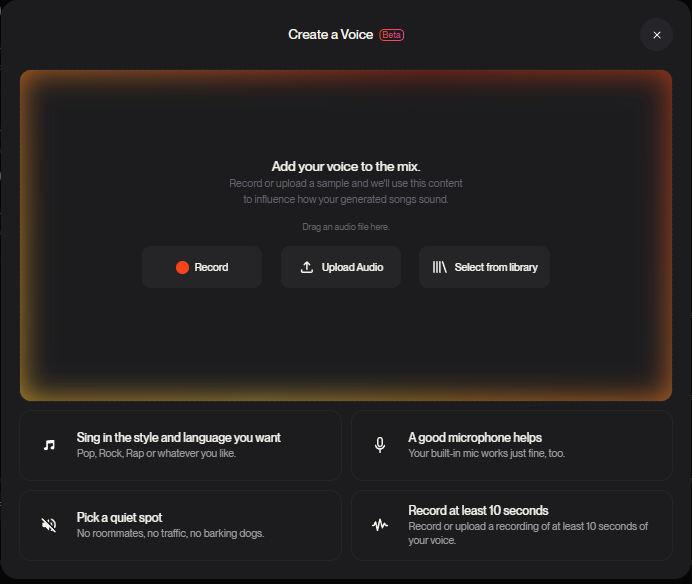
- Record or upload a voice sample. An a cappella clip works best, but you don’t need a perfectly clean one — Suno can isolate your vocal from a recording that has background music using stem separation. Just grab your phone and a quiet moment and sing.
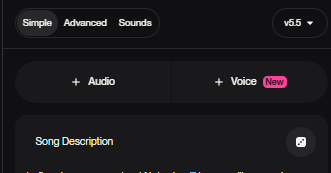
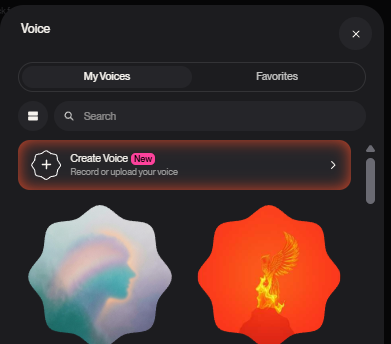
- Click the “Voice” button. Upload your vocals to Suno.
- Do a quick live verification. You’ll read a short phrase back to confirm it’s actually your voice. This isn’t just a formality — it’s Suno’s way of making sure people aren’t cloning voices of famous people.
- Generate a song like normal. Write your style prompt, enter your lyrics, and then click the “Voice” button again and select your voice profile. That’s it — the song comes back with you as the vocalist.
No studio, no engineer, no fifteen takes of the bridge because you cracked on the high note.
The stuff nobody tells you
A few things I wish I’d known:
Give it more than a few seconds. The temptation is to upload a tiny clip and call it done, but variety is what makes the model flexible. Soft parts, loud parts, different moods — the more vocal range you feed it, the less robotic the result sounds.
No fancy gear needed, just a quiet room. You don’t need a studio mic, just your phone. You need an echo-free room and a clean take. Suno’s own guidance is basically standard vocal-recording common sense: warm up first, do a practice take, an authentic vocal performance is better than a “perfect” one.
It’s a paid feature. Voice cloning currently is only part of Suno’s Pro and Premier plans, not the free tier.
When it’s not quite “your real voice”
Worth being upfront about this: if what you actually need is your exact, human vocal performance — every breath and imperfection intact — this feature isn’t that. It’s a generated performance guided by your vocal identity, not a recording of you. If a project truly needs your unaltered voice, the more reliable route is still to record your own vocal and mix it onto an AI-generated instrumental, which plenty of creators do by separating the stems from a Suno track and layering their real take on top.
Think of it less as “cloning” in the deepfake sense and more like a really good vocal coach that that has your voice in mind and now writes new material specifically for your range.
Why this is actually a big deal
The interesting part is that this feature unlocks pretty much the full production pipeline of music. If you can hold a tune but can’t arrange, produce, or hire a band, you can now generate a fully realized track that still sounds identifiably like you — for demos, personal projects, gifts, or monetization.
Keep following for more on AI song creation with Suno.